





How Personalized Hero Sections Help you Get More Conversions
How many times have you redesigned your website because you were not getting any conversions? You reviewed the data, saw the bounce rate increasing, and wondered what might be wrong. You call your designer, ask your content writer to update the copy, and hope that a new look will do the trick. It often feels like the obvious next step.
However, suppose the true problem is not your entire site? What if it’s only one tiny part that has the most effect and opportunity? According to research, it only requires 50 milliseconds, or 0.05 seconds, for someone to pass judgment on your site. During this time, they check out just one thing: your hero section. It is the uppermost segment of your page. It consists of the headline, the image, and the CTA button. It is what users will first see before scrolling and before they start reading anything else. And, most importantly, it decides whether they stay or leave.
What’s shocking is that most sites have the same hero section for every single visitor. Just a generic message, no matter who’s visiting. But people aren’t the same. And for that you don’t need a complete redesign. Just personalize your hero section. And it works too. According to McKinsey, companies that do personalization will end up earning 40% more revenue than their non-personalization peers. The best part? This can be initiated without the need to revamp the entire site.
In this blog, we will discuss why the hero section is the best place in this digital world, why you should personalize it and how to get started. We will explore some actual examples, some of the tools that can assist, and easy methods to track whether it is being productive.
1. Why Your Hero Section Is Your Most Valuable Digital Real Estate
The hero section is your most precious digital real estate. It is the first thing visible to a visitor and often the only thing they notice before deciding to either stay or leave. For a quick audience-grabbing and trust-building initiative,this is the place to start.
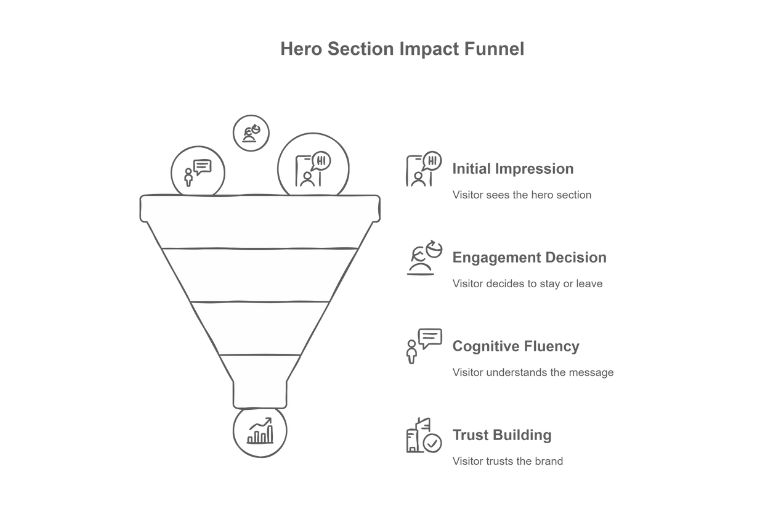
Everything that a user sees before scrolling on a webpage is referred to as above-the-fold. This is basically the front window of a shop, behind which people glance, and soon afterwards, decide whether or not they want to move indoors. That front window, in technical jargon, is called the hero section. According to reports, on average, visitors spend about 5.94 seconds looking at your main image and 5.59 seconds reading what you’ve written. That’s not much time to make an impression. And when the message fails to resonate, almost half of them just walk away. That’s a lot of missed opportunities. And that’s why this part of your website deserves attention.
For a moment, think about how our brain works.When a certain thing is easy to comprehend we feel good about it. This is what is referred to as cognitive fluency. Similarly, if your hero section tells the visitor what they need, it reduces the mental load and builds instant trust. But if it is vague or irrelevant, then the brain quietly says no thanks and moves on.
Consider a B2B SaaS brand that uses the following hero message “The Number One Platform Business Growth”. That is generalized and smooth, yet somewhat generic. Suppose instead it says “The Number One Platform to Grow Financial Services” to a visitor in the banking business. This small edit makes the message seem that it was sent solely to them. It is more familiar and is closer to the point and thus, more likely to incite an action.
And remember, 88 percent of online consumers claim not to come back after a poor experience. The stat alone demonstrates the stakes. Therefore, rather than viewing your hero section as a banner, consider it as a conversation piece
Read: Understanding the Personal Injury Claim Process: What Plaintiffs Should Expect
2. Key Elements That Make Your Hero Section Work
Now that we’ve seen why the hero section is so important, let’s take a closer look at what actually makes it work.
- The Headline:
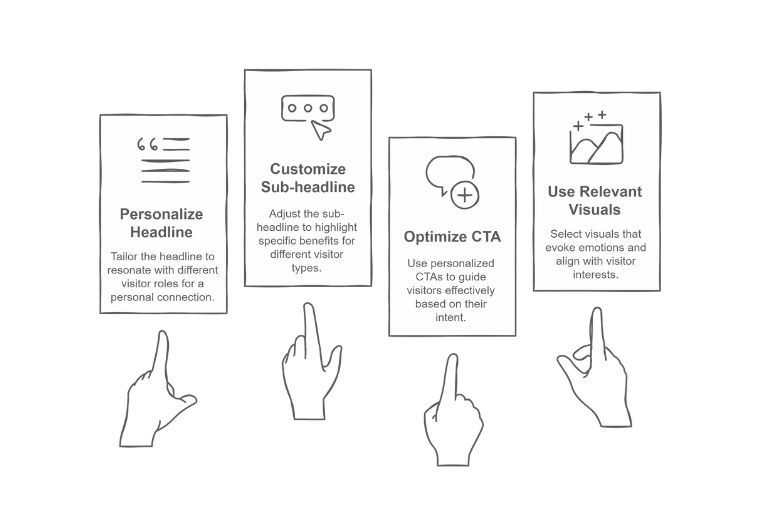
The headline is the most readable part by a visitor and it should go beyond merely being clever. It must mean something. Consider a revenue intelligence system that displays a modified title based on who visits the site. A Marketing Manager would view a message like, “See How Your Content Influences Deals,” whereas a VP of Sales would view, “Unlock Your Team to Its True Sales Potential.” The value is always personal, though the message varies. It is the power of personalization. - The Sub-headline:
And next comes the sub-headline. This section is often overlooked, but it can add a significant amount of depth to your message. While the headline grabs attention, the sub-headline provides context. Instead of using the same plain line for everyone, you could customize this message to speak about specific benefits. A subheadline for a startup visitor might cite speed and affordability, whereas for an enterprise client, it could cite security and scalability. You are still offering the same product, but it makes all the difference to speak their language. - The Call-to-Action (CTA):
CTAs or Call-to-Action are elements that guides visitors towards the next step. But here is a catch: “Learn More” versus “See Fintech Demo” makes all the difference between someone’s clicking or bouncing. Based on the Hubspot report, personalized CTAs perform over 200 percent better than generic ones. That’s a number you certainly cannot ignore. Therefore, rather than sticking to one universal button, why not customize your CTA to match the visitor’s intent? “Get Your Retailer Kit” sounds much more appealing when one is actually addressing a retail audience. - The Visuals (Image/Video):
And, of course, the visuals. These do most of the heavy lifting in terms of emotions. A relevant picture or video can instantly immerse your visitor into the comforting feeling of being in the right place. Once again, in the case of our revenue intelligence platform- for the VP of sales, a view of a team dashboard at a glance feels empowering. For the Marketing Manager, a report that speaks of campaign-influenced revenue feels like validation. It is not only aesthetic. It is about finding the way to make a person feel noticed.
And this works: BMW sent just over a thousand personalized multimedia messages, registering a conversion rate of 30 percent higher in the conversion area. Just by using people’s names and tailor-made content. In another case, Dropbox A/B tested button labels like “Find your Plan,” “Start for Free,” and “Get started.” As it turns out, “Find your Plan” performed the best. Small changes, big impacts.
3. How to Personalize Your Hero Section with Data
Having talked about it earlier on how merely a small tweak in messaging such as identifying the visitors industry can totally alter how they feel towards your business. The obvious question then must follow is how to make this sort of thing at scale? without having to rewrite the homepage each day.
The answer lies in personalization. Not the feel-good type, but data-powered, actionable personalization that will make your hero section more intelligent. And more welcoming.
- Firmographic Personalization
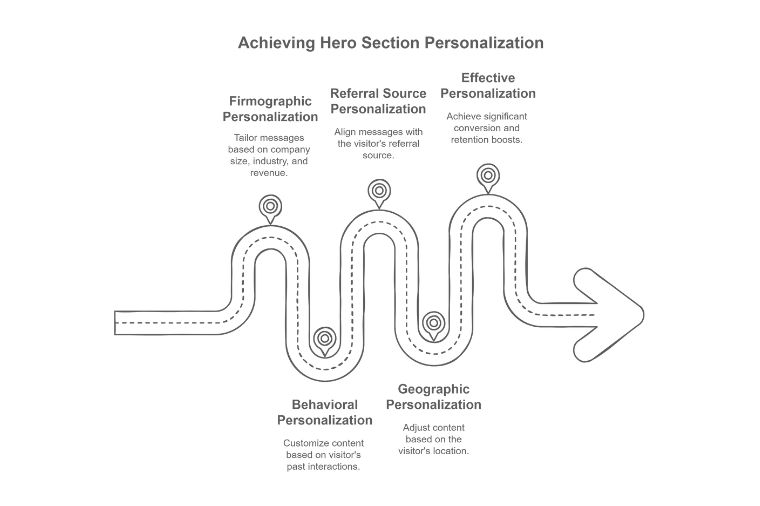
It’s most helpful for B2B websites. You can personalize your hero message by the visitor’s company size, industry, and revenue or the tools they already use. For example, if a startup founder from a tech company visits your site, your message could highlight speed and agility. But if it’s someone from a large bank, your hero might emphasize compliance and reliability. Both see the same brand, but with a message that feels just right for them. - Behavioral Personalization
Not every visitor requires the same welcome. A first-time visitor might need a quick introduction to what you do. A visitor returning after a few days could be shown a message that says something like, Welcome back, ready to pick up where you left off? A bit of well-placed follow-up adds to the feeling of familiarity, which in turn builds trust. And, as we have seen, that trust is key when you only have a few seconds to make a connection. - Referral Source Personalization
The information about the origin of a visitor tells much concerning what he/she may be expecting. If someone clicks a Google ad that says free trial, your hero section should reflect that. If he/she came from a LinkedIn post concerning your latest case study, your hero could feature a link to download it straightaway. Matching their intent with your message reflects that you’re paying attention, and that’s rare enough to stand out. - Geographic Personalization
Such a type of personalization is simple but effective: a visitor from London can see prices in Pounds whereas someone from Singapore sees a case study about a local brand. Such little customizations could make your messages feel more familiar and relevant to the target audience. And this familiarity tends to reduce resistance, making the audience more likely to explore deeper into your offering.
Consider a Nike guest landing on a website like Clearbit’s. The site can then employ its data tools to identify the visitor’s company and update the hero section to say something like, The Data Powering the World’s Top Retail Brands. It might even show a Nike-related success story. All of a sudden, the page doesn’t seem generic anymore. It feels as if it were made for them. That’s the whole idea: not just changing words but creating moments where the visitor feels seen.
Now the questions that may be rising in your mind may be, is this effort really effective? Statistics answer yes. B2B buyers are two times more likely to interact with companies that personalize their advertising. According to McKinsey, when companies segment their audiences well increase conversions by as much as 10 percent and retention by 15 percent. And when personalization is effectively implemented, it can boost income by up to 25 percent.
Section 4: Tools That Help You Personalize Your Website
Personalization is important, and functional, but this leads to a question marketers frequently inquire about. How can I practically do all this without having a team of engineers?
This is where the tech stack kicks in. With the proper tools, these brilliant ideas that we spoke of previously can be transformed into real-time personalized experiences, that scale. You might be injecting custom hero text to a particular firm, as we discussed above with Clearbit and Nike, or you might be displaying different messages based on referral sources or user behavior, in all of these cases you require a high performance engine running in the background.
Website Personalization Platforms
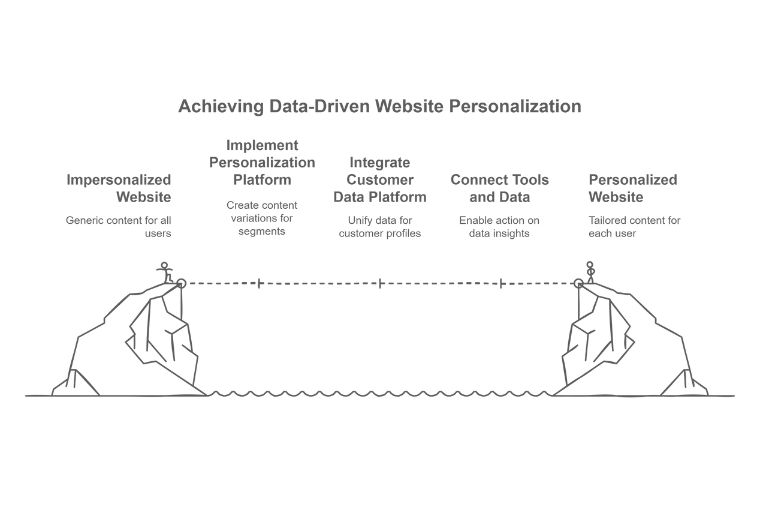
These platforms allow marketers to personalize content without having to touch code. Think of it as your command center. A web personalization platform allows you to create different versions of your hero section for different segments. You could target by firmographics, behavior, referral source or geography all of the stuff we discussed previously.
Customer Data Platforms (CDPs)
While personalization platforms assist in delivering personalized content, Customer Data Platforms inform you as to what to deliver. CDPs unify data from your CRM, email campaigns, support tickets, and much more, to create thorough customer profiles. Tools like Salesforce CDP serve as your personalization brain. They enable much smarter targeting and deeper personalization because they connect the dots across all these different touchpoints. This becomes particularly powerful when trying to deliver messages that feel consistent across your website, emails, and ads.
Why This Tech Matters Now More Than Ever
The emergence of these tools is not a hype. It is estimated that the global market size of marketing automation will grow by 6.6 billion dollars in 2024 to 15.5 billion dollars in 2030. Such growth is a clear indicator that more companies are investing in personalization at scale.
And here is the catch. Based on the research, 63 percent of marketing leaders admit that data-driven personalization is the most difficult technique to implement. Not due to the lack of ideas, but due to the lack of the ability to connect the right tools and data, which is often a true challenge.This is why at Fragmatic, we work on how to make personalization more friendly to the B2B marketing community. The aim is straightforward, to enable teams to take action on their data and customize where it counts, without having to recreate everything.
5. Metrics to Track Hero Section Performance
All marketing initiatives ultimately boil down to this: return on investment. And your hero section is not an exception. So how do we measure that our personalization efforts are paying off?
- Start with Core Metrics
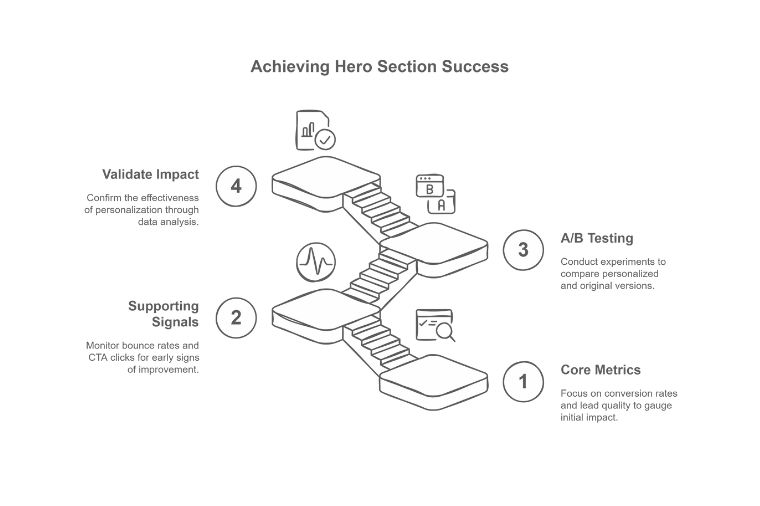
Concentrate first on metrics that directly tie to business results. Conversion rates, lead quality, and increased requests for demos or sign-ups are telling signs of whether your hero section is working. If you’ve attracted better leads and booked more demos, then personalization is proving well for you. - Monitor Supporting Signals
The large metrics are the most important but one can have an edge using early signals. Metrics like bounce rate, average time on page and CTA click-through rates tend to improve before pipeline metrics move. You can observe them quickly and see whether the changes you are implementing are in a proper direction or not. - Validate Through A/B Testing
To demonstrate impact, A/B testing is the most effective means possible. Comparison of how your original hero section performs against a personalized one can be done by setting up A/B experiments and tracking effectiveness across different audience groups. This allows you to identify specifically what is working and what is not.
Imagine a B2B SaaS organization focusing on healthcare leads that saw an opportunity to optimize their hero. Their default heading is titled, “Streamline Your Operations. In the personalized version, they made it more specific to read, Streamline Your HIPAA-Compliant Operations. This minor change had a huge effect. In less than a month, the number of demo requests submitted by healthcare visitors increased by 35 percent, and bounce rates decreased by 20 percent. The customized message appealed directly to the priorities of their audience, and it was reflected in the statistics.
When tailored correctly, personalization does not make one feel effective but proves it. In fact, many companies that use modern personalization techniques frequently report a $20 return for every $1 spent. With the right data and a bit of testing, your hero section can become one of the highest-performing parts of your website.
Conclusion
The most valuable digital real estate on a website remains the hero section, and personalizing the same proves one of the simplest and quickest methods for augmenting performance. There is no need for a grand redesign or months of planning; small things strategically implemented based on data can yield some remarkable results-from enhanced engagement to improved conversion.
Marketers can start today instead of waiting for the next overhaul. Identify the visitor segment that matters most to you, and find at least one simple way to customize the hero section to respond to that segment’s needs. That one step is often enough to set the stage for much better outcomes and a much higher ROI.
Author’s Bio:
Vidhatanand is the Founder and CEO of Fragmatic, a web personalization platform for B2B businesses. He specializes in advancing AI-driven personalization and is passionate about creating technologies that help businesses deliver meaningful digital experiences.